Supplement 1.8: Lambert emitters, cosine emitters (2/4)
Further examples ...Continued from previous page
Plastics
Many plastics exhibit a cosine characteristic, provided they are optically dense and the surface is matt, i.e. does not show any gloss effects. Examples include white polyethylene (PE), white polyvinyl chloride (PVC) and white satin-finished Plexiglas (PMMA), as well as foamed plastics such as polystyrene. Coloured plastics can also be cosine scatterers at wavelengths at which they do not absorb.
In physical optics, Teflon (PTFE) in chemically pure form is used as a cosine reflector under the name Spectralon®. The polymer consists of porous molecular chains that cause multiple reflections near the surface, which is why the light is diffusely scattered. The reflectivity is >99% for wavelengths from 400 to 1500 nm and >95% from 250 to 2500 nm. Spectralon® is therefore used as a white reflection standard, for example in the colour analysis of paints.
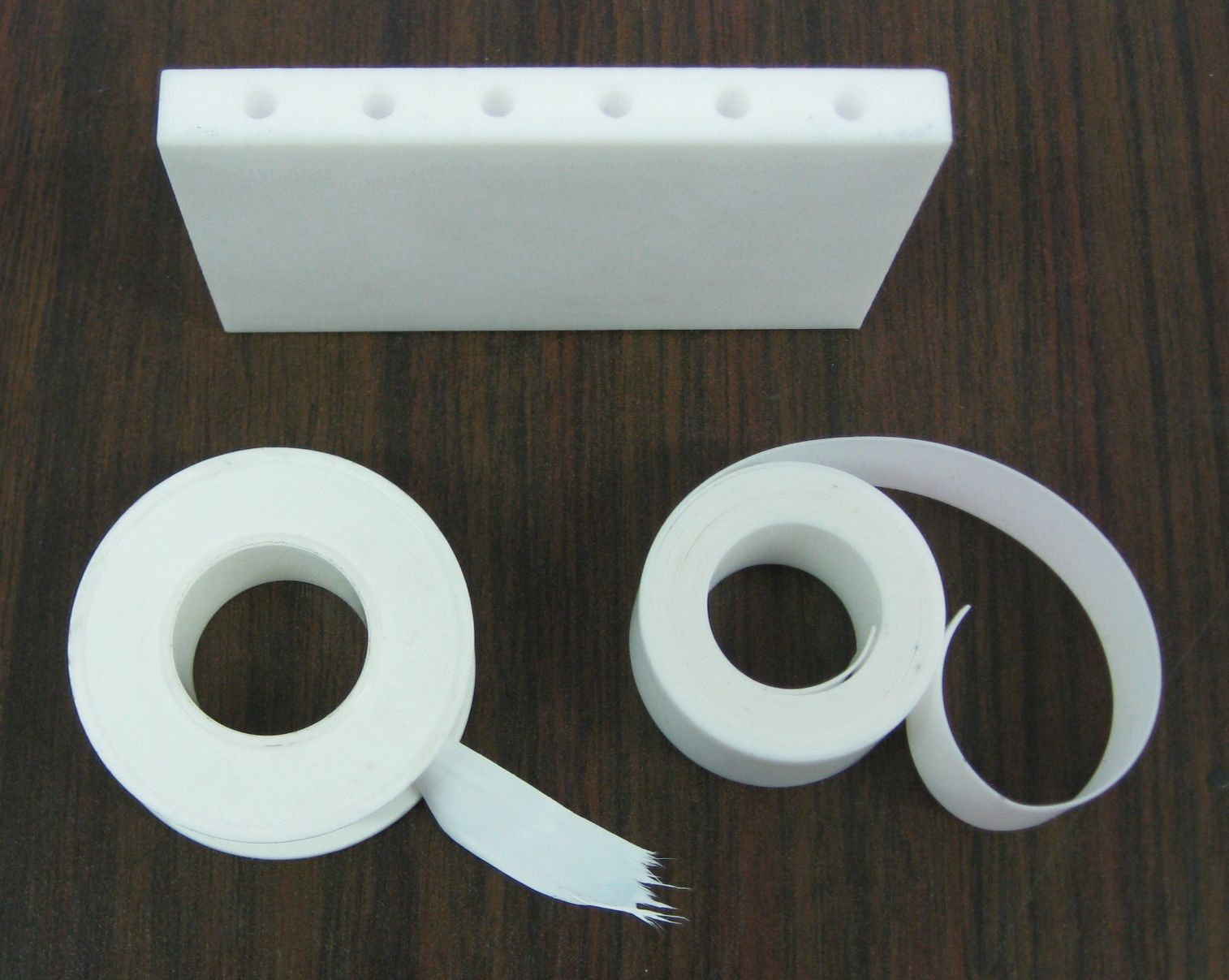
Source: Wikimedia Commons, author: Cjp24.
White walls, white glass panes
As noted on the previous page, the intensity of a cosine emitter or cosine diffuser decreases in proportion to the cosine as the viewing angle increases. How can it be explained that a white wall appears just as bright when viewed at an angle as when viewed perpendicularly? Even a frosted glass pane does not appear to change its brightness when the viewing angle is altered.
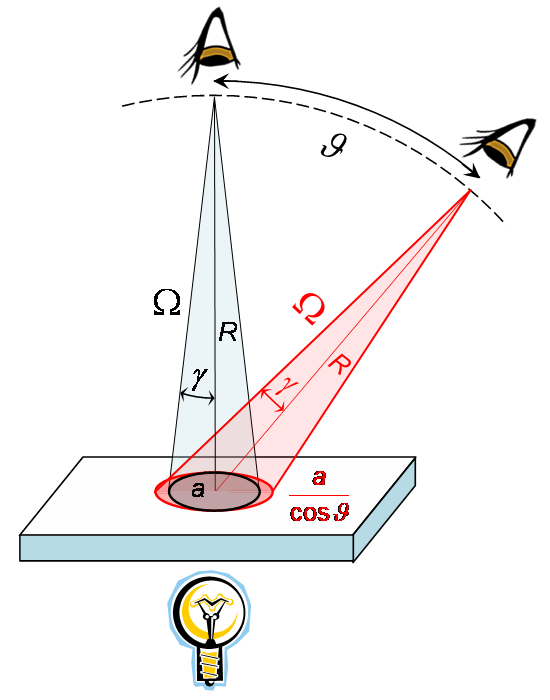
The area on the glass seen at the solid angle Ω is equal to a when viewed perpendicularly (dark blue circular area). This area is then enlarged when viewed at the angle ϑ: a/cos ϑ (red elliptical area). For a cosine emitter, on the other hand, the beam intensity emanating from the glass at an angle ϑ is smaller by a factor of cos ϑ than when viewed perpendicularly. Both effects cancel each other out.